Mom lived three more years. I was on my way for a visit in the spring of 1997 when I received a phone call upon getting into Los Angeles. It was Don. He told me that Jodi Spiegel, Ellie’s middle child from her first marriage, had died suddenly of a brain tumor. She had been having severe headaches for weeks. Don had helped raise Jodi and her two sisters since she was eight years old. They were still at the hospital, in shock, and not sure they would be able to pick me up as planned. I told them not to worry, I’d find my way, but they managed, and were waiting when I deplaned in San Diego.
I stayed with Mom at her one-bedroom apartment. Her rental was in a small retirement community of four two-story buildings that enclosed a beautifully landscaped courtyard - rather charming. There were gates at each corner, one lead conveniently to a strip mall and grocery. Don and Ellie lived only a couple miles away.
The clan gathered at Don and Ellie’s place each evening during those sad days. The core group included more than a dozen people: Ellie’s surviving daughters, Stephanie and Susan, along with their families, her first husband, Jerry Spiegel, and Don‘s sons, Lee and Dennis Buckingham, who flew in from Indiana. They planned a memorial service for Jodi at Dog Beach in San Diego, a favorite of Jodi as she had often taken her dog there. It was an entertainment to see the dogs frolicking in the waves, seemingly with
out a care in the world. A pavilion was pitched on the beach, and the service consisted of friends and family taking turns telling remembrances of events that they had shared with Jodi.
One evening, as I was helping Mom into the car to take her back to her apartment she let me know she would be interested in trying some pot. This was a bit of a surprise. She had been a smoker all her adult life, but never showed the lease interest in the stuff of Reefer Madness. She had, no doubt, smelled the characteristic aroma of the weed wafting through the group that night, and I suspect her dormant curiosity became aroused. Maybe she had always been curious, but the opportunity had never presented itself at a convenient time. But she was in California now, land of liberalism, so why not join in. Besides, what did it matter at that stage of her life. I told her I would see if someone could help her.
Jerry Spiegel was known to be a connoisseur, and the next evening he presented Mom with a joint. She immediately took a puff, inhaled deeply and started coughing. She coughed for several minutes, loud and hurtful hacks, with big tears rolling down her cheeks. She never finished her joint, never got to experience a marijuana high. Most everybody smiled sheepishly, and I think all felt sorry for her, though the sympathy might have followed different paths of reasoning.
Mom never got into the California niche, once admitting to me of feeling overwhelmed by the move, and not able to make herself get involved. She was depressed and withdrawn.
There were plenty of activities at the senior complex. Don said they passed the community room on one occasion where a number of residents were playing cards and kibitzing. It looked like a lot of fun, but they were on their way to dinner, and didn’t stop. He regretted not taking her in as it was a perfect opportunity to introduce her to the new neighbors as Mom was not the type to boldly go in on her own.
Mom stayed in the apartment for a little over a year before Don moved her into a care facility. She had a series of small strokes that robbed her of short-term memory. Don was devoted in his caretaking, going over every day to spend time with her. I visited a last time a few months before she died, and took our newly adopted boy, John. We visited at the hospice. Mom was confined to a wheel chair. We strolled with her out the walk around the facility. She stopped to ask about the name of a flower along the path‘s edge. Don said she asked that same question every day. Mom died a month later on May 5th, 1999, four and a half months short of 86.
Showing posts with label Frank. Show all posts
Showing posts with label Frank. Show all posts
Tuesday, November 15, 2011
Part 5 - Hazel and Friend Bob Visit Alaska
 |
| Mom and Bob Eschelman at Portage Glacier, Alaska, 1993 |
 |
| Bob, Mom and Mary at Garage Sale in Anchorage, Ak, 1993 |
 |
| Mom and Bob at neighbors for a Salmon Bake |
In August they flew into Anchorage. Mary and I waited for them to deplane at the gate. The passengers filed out, and we stood there as the last trickled by. Then Mom came out trailed by a flight attendant shoving Bob in a Wheel chair. He suddenly rose from the chair, tripped on the foot rest, and fell flat on his face. He was drunker than a skunk, and Mom was beside herself with anger and embarrassment. We got him back in the chair. The attendant informed me that if I didn’t take responsibility she would have to turn him over to airport security. I was tempered to decline the option, but agreed to see after him. It seems Bob had bought two bottles of Absolute Vodka just before departing the Minneapolis Airport. Mom hide them in her purse on boarding, and Bob preceded to have a four thousand mile party.
 |
| Mom and Bob in boat returning to Cabin, 1993 |
 |
| Bob and Mom at Window all Day |
 |
| Bob and Mom at window at night |
 |
| Bob, Mom, Joe and Mary at Farewell Celebration, 1993 |
GO TO: Part 6 - Hazel's Life Without Her Friend Bob


Part 4 - Hazels' Life After She Renewed an Old Friendship
It turned out that Mom’s “boyfriend” was Bob Eschelman, a person I‘d known for many years. I’d met him in the sixties when I bartended at the Moose Lodge, and Bob was one of the two full-time bartenders, working there for many years, possibly till his retirement. He and his wife had been at Dad’s funeral. She died a couple years after that.
Bob was a jovial fellow with a mischievous smile perpetually pasted on his face. He liked to drink, was fun loving, and partied till his dying day. I went with him on one occasion when he run his “trap lines”. That is what he called his daily round of visits to a string of local clubs: VFW, American Legion, Eagles and the Moose Lodge. He had a drink at each one, visited with the bartender and fellow patrons, and then went on to the next. Bob never appeared to be drunk, but did manifest a watery-eyed glow through most of each day. He had a spontaneous nature, and didn’t seem to put much thought into contemplating the consequences of his actions, he just did them.
Mom told me that Bob grew up only child of a prominent family in Anderson, Indiana, hinting that he had been a bit spoiled. He was a wiry little guy, a veteran of World War II, and had served in Europe through most of it. I remember something about the “Battle of the Bulge“. He might have been a prisoner-of-war, though I’m not certain of that. I often wondered if the war might have had something to do with his laissez-faire approach to life, and the uncomplaining toughness that I liked about him .
One time in 1989, after one of my visits to, Mom and I had planned to fly to California to visit my brother and his wife, Don and Ellie. Bob volunteered to drive us to the Indianapolis airport. He arrived a bit late to pick us up, but there was still time to comfortably make it. Kokomo is a long narrow town, measuring two miles on its east-west axis and eight miles north-south. Mom’s house sat on the eastern edge. When Bob pulled out of the driveway he turned west toward the center of town instead of east which would have taken us the half-block to the by-pass and quickly around town. He drove to the center, turned south weaving his way through perceived shortcuts, and finally reached the south edge of town and open road.
It was then that Mom realized she had forgotten her airline ticket. We had to go back to the house. Bob could have taken the by-pass back but retraced his way back through town. Mom retrieved her ticket and Bob started back through town, but I intervened. Now we were running late so Bob sped down the road only to be stopped and ticketed. That took another ten minutes. It did not seem probable but we did make the airport on time.
GO TO: Part 5: Hazel and Her Friend, Bob, Visit Alaska
Bob was a jovial fellow with a mischievous smile perpetually pasted on his face. He liked to drink, was fun loving, and partied till his dying day. I went with him on one occasion when he run his “trap lines”. That is what he called his daily round of visits to a string of local clubs: VFW, American Legion, Eagles and the Moose Lodge. He had a drink at each one, visited with the bartender and fellow patrons, and then went on to the next. Bob never appeared to be drunk, but did manifest a watery-eyed glow through most of each day. He had a spontaneous nature, and didn’t seem to put much thought into contemplating the consequences of his actions, he just did them.
Mom told me that Bob grew up only child of a prominent family in Anderson, Indiana, hinting that he had been a bit spoiled. He was a wiry little guy, a veteran of World War II, and had served in Europe through most of it. I remember something about the “Battle of the Bulge“. He might have been a prisoner-of-war, though I’m not certain of that. I often wondered if the war might have had something to do with his laissez-faire approach to life, and the uncomplaining toughness that I liked about him .
One time in 1989, after one of my visits to, Mom and I had planned to fly to California to visit my brother and his wife, Don and Ellie. Bob volunteered to drive us to the Indianapolis airport. He arrived a bit late to pick us up, but there was still time to comfortably make it. Kokomo is a long narrow town, measuring two miles on its east-west axis and eight miles north-south. Mom’s house sat on the eastern edge. When Bob pulled out of the driveway he turned west toward the center of town instead of east which would have taken us the half-block to the by-pass and quickly around town. He drove to the center, turned south weaving his way through perceived shortcuts, and finally reached the south edge of town and open road.
It was then that Mom realized she had forgotten her airline ticket. We had to go back to the house. Bob could have taken the by-pass back but retraced his way back through town. Mom retrieved her ticket and Bob started back through town, but I intervened. Now we were running late so Bob sped down the road only to be stopped and ticketed. That took another ten minutes. It did not seem probable but we did make the airport on time.
GO TO: Part 5: Hazel and Her Friend, Bob, Visit Alaska
Part 3 - Hazel's Life after Dad Died in 1985


The trouble with living a long life is that you out-live most everyone else. One of her friends sat in the front row at Dad’s funeral. I no longer remember her name, Bernice maybe, but she and Mom had been the best of buddies since the sixties, did a lot of things together. The woman had emphysema, and breathed with difficulty. I heard that she passed a short time later.
Mom was the last of her generation to go. She outlived her three brothers, and Dad’s four siblings - family members of whom I’d known from my beginning.


GO TO: Part 4 - Hazel's Life After She Renewed an Old Friendship
Part 2 - Hazel's Life in the 1940's and 1950's


She ironed clothes at Riggs Dry Cleaners shop for several years in the early fifties. It was a true sweat shop in a small building behind the Riggs’ house. We picked her up at 5pm in the evening and the shop was sometimes so hot that I could not stay inside. She took some courses at the local business school, typing and bookkeeping, and went to work for the Moose Lodge as Dad’s assistant in 1953. She worked in the Moose office until she retired some twenty years later.


We gathered at home again around five or six. Grandma Frank usually made supper, and by seven the dishes were done and Mom laid down on the living room couch to watch some television. Sometimes, early on, she would spoon with Dad as he lay at the back of the couch and she cradled in front. Other times she crashed alone, but she invariably fell asleep and missed most of the nights TV shows. She’d awake, sleepy eyed, about ten or eleven and go off to bed. Five or six hours later the pattern would repeat, and you could again hear quiet padding about the house.
Mom was a smoker. I don’t know when she started, but I suspect she began in her teens. She came from tobacco country, and I expect she saw nearly everyone around her smoking while she was growing up. Phillip Morris cigarettes were her choice when I was young, and later she switched to Kools and Salems. As a kid I heard her hacking cough almost every morning. She smoked to nearly the end of her life, but emphysema eventually destroyed her lungs.
A low point for the family came the year after I graduated from high school. Dad had an affair with a divorced woman who was affiliated with the Moose Lodge. Mom got suspicious and had me drive her by the woman’s house on more than one occasion. One night, as we drove through the alley behind the house Mom spotted Dad’s car in the drive way.
She had me stop and then left the car, picked up a board in the offending woman's yard and broke a window in the back of her house. She then proceeded around the house smashing one window after another. I watched in stunned disbelief as Mom sent shock waves of smashed glass resounding through the neighborhood. I had only a vague notion as to why she was having me drive her, and no idea about what she planned to do. Dad came out about the time she reached the front. He put her in his car and drove away.
A day or so later two police officers stopped by at midnight with a warrant and took her to jail. It was the worst time our family ever had. I felt used by Mom for dragging me into it, and I was angry at Dad for the betrayal. It was not pleasant around the house for a while, and I never did hear the outcome. I assume someone in the family paid for the broken windows. I do not love them any less for what happened. There was a lot more good than here ever was bad.
GO TO: Part 3 - Hazel's Life After Dad died in 1985
The Life of Hazel (Frank) Buckingham (1913-1999)

Mom always claimed she would never live long enough to see Halley’s Comet, but 1986 came and went, and she was still here. She said she would never make the Millennium, and proved herself right on that one - she died Cinco De Mayo, 1999. Mom often saw the darker side of things, so her prediction of an early death, at 85, was understandable. She was a nice person, even gentle, but her outlook was fatalistic. She accepted life as something of which she had little control, but was frustrated by her powerlessness. Mom often groused against the injustices and stupidities of the world, and she especially loved to hate politicians.


Happiness is a phoenix with a short life span. There were many times when she was buoyed with a smile or laughing at a joke. She loved to play Euchre and I remember her sitting in a foursome at the Moose Lodge on many occasions. She worked crossword puzzles, and read lots of books. She could be on a high for weeks, but the mythical bird of happiness would eventually crash and burn. She did not plunge into an emotional darkness, but simply leveled off flat after a shallow dive. A lot of people who are depressed can be irritable but it wasn't her way. I never recognized it then but now realize she probably suffered mild depression most of her life.


Mom was born in a railroad car in eastern Kentucky on September 17, 1913. She went by Hazel Mae Frank, but her birth certificate indicated that she was "Mary Frank". She didn't know why that name was on it, and was never given an explanation. Mom once told me that she always felt like an outsider in her own birth family.

She had three older brothers, Art, Charlie and Joe. The family returned to Catawba Kentucky shortly after she was born. It was her parents hometown, and both their families still lived there. Her maternal grandparents, Charles and Julia Jacobs, died the year before she was born, but her Pop’s parents, George and Mary Frank, were still alive.
She grew up dirt poor because her Pop too often drank up his paycheck. He had a good job with the railroad, but was a bit crazy and several of Mom’s stories about his escapades are hair raising. Catawba was an L&N Railroad creation. There wasn’t much to it then, and it’s not even a ghost town now. The old town is gone, the Jacobs family home was razed years ago, and there is new house sitting where it stood. Their graves lay in a far corner of its backyard.

The family left Catawba in about 1919 and spent a couple years outside Cincinnati before moving on to Connersville, Indiana when she was nine. She quit school after her sophomore year, and was working at the Auburn Auto Company when she met Dad in 1935. They married in June of 1936 and moved to Kokomo, Indiana the following year
GO TO: Part 2 - Hazel's Life in the 1940's and 1950's
Wednesday, March 2, 2011
The Life of Calla Della Jacobs - Part 4b, The Move to Kokomo, Indiana
Grandma had a stroke after undergoing a gall-stone operation in the fall of 1958. The family visited her in the hospital the evening of the stroke. She was cheerful, excited that she was to be released the next day. They called in the middle of the night, and we rushed to the hospital to find a different person. She lay there limp, her head to the side, eyes open and mouth agape - no response, no sign of recognition. Things were never the same.  She was paralyzed on her right side and lost the ability to speak. Words came in a meaningless tangle. She eventually stopped trying to talk, getting by on grunts and shaking her head as we played twenty questions. Even that could be confusing as she would often shake her head “yes” when she meant “no” and visa versa.
Grandma lived another ten years in that sad condition, ever confined to bed or a wheel chair. Her right hand was shriveled from disuse, and she kept it buried under a small towel We tried to keep her at home those first years, but she required assistance for even the most basic of functions.
For a while her four children chipped in to hire a lady to care for her. Hazel Williams, a black lady, worked with Grandma for nearly a year. Hazel was recently widowed, and lived only a few blocks away. She probably needed the money, and we all liked her. She was robust and cheerful, cooked for the family, did some house work, and was Grandma’s constant companion. Grandma really loved her, and was happy, but Hazel was too expensive, and none of the children had the wherewithal to sustain the cost, so they had to let her go.
We tried letting her stay alone in the house with someone looking in now and then. One day I came home to find her sitting in the living room floor. The front door had blown open and she had gotten out of the wheelchair and crawled over to shut it, but was trapped for several hours. I remember to this day the big tears running down Grandma’s cheeks as she sat in the wheelchair begging to be allowed to stay at home. We couldn’t understand her words, but we knew what they meant.
The ordeal was starting to show on Mom. She was running herself sick, so we moved Grandma to Connersville, close to her other children, where she bounced from one rest home to another. She stayed a couple years, but was never happy. She wanted to go home.
We brought her back in 1966. She stayed at the Good Samaritan nursing home on Vaile Street, and we could take her for rides and home for visits. I stopped to see her and say goodbye when I left for Alaska in June of 1967. She signaled her amazement that I was traveling so far, and seemed to know that it was to be our last meeting. Grandma Frank died on January 30th of the following year. She was 84 years, 8 months and 7 days old.
THE END
GO TO: The Story of Grandma's Mother's Parents, the Baileys
She was paralyzed on her right side and lost the ability to speak. Words came in a meaningless tangle. She eventually stopped trying to talk, getting by on grunts and shaking her head as we played twenty questions. Even that could be confusing as she would often shake her head “yes” when she meant “no” and visa versa.Grandma lived another ten years in that sad condition, ever confined to bed or a wheel chair. Her right hand was shriveled from disuse, and she kept it buried under a small towel We tried to keep her at home those first years, but she required assistance for even the most basic of functions.
For a while her four children chipped in to hire a lady to care for her. Hazel Williams, a black lady, worked with Grandma for nearly a year. Hazel was recently widowed, and lived only a few blocks away. She probably needed the money, and we all liked her. She was robust and cheerful, cooked for the family, did some house work, and was Grandma’s constant companion. Grandma really loved her, and was happy, but Hazel was too expensive, and none of the children had the wherewithal to sustain the cost, so they had to let her go.
We tried letting her stay alone in the house with someone looking in now and then. One day I came home to find her sitting in the living room floor. The front door had blown open and she had gotten out of the wheelchair and crawled over to shut it, but was trapped for several hours. I remember to this day the big tears running down Grandma’s cheeks as she sat in the wheelchair begging to be allowed to stay at home. We couldn’t understand her words, but we knew what they meant.
The ordeal was starting to show on Mom. She was running herself sick, so we moved Grandma to Connersville, close to her other children, where she bounced from one rest home to another. She stayed a couple years, but was never happy. She wanted to go home.
We brought her back in 1966. She stayed at the Good Samaritan nursing home on Vaile Street, and we could take her for rides and home for visits. I stopped to see her and say goodbye when I left for Alaska in June of 1967. She signaled her amazement that I was traveling so far, and seemed to know that it was to be our last meeting. Grandma Frank died on January 30th of the following year. She was 84 years, 8 months and 7 days old.
THE END
GO TO: The Story of Grandma's Mother's Parents, the Baileys
Tuesday, March 1, 2011
The Life of Calla Della Jacobs - Part 4a, The Move to Kokomo, Indiana
 I think life got better for Grandma in 1937 when Mom and Dad invited her to come live with them in Kokomo. She acted as mid-wife when I was born in 1939, was part of the family from my earliest memory, shared the house work, and went on vacations with us. Grandma was always there to comfort Don and I. I remember calling her “Mom” for a number of my early years, though I did know the difference.
 She had her own bedroom, and did much of the cooking with Mom’s help. She regularly prepared a variety of Midwestern meals such as fried chicken, chicken fried steak, roasts, beans, and fried or mashed potatoes. Her pies were great with the lightest of flaky crusts. Grandma’s only short-coming, according to her, was that she could never get the dumplings right - they didn’t rise properly or something… or the other. They tasted okay to me, but then again, I had never sampled the perfect chicken dumpling that she envisioned.
  Being a good cook helped to make her financially secure, as she got a job at the Guarantee Restaurant on Main Street shortly after arriving. As far as I can remember, she always had that position, and worked it till her retirement in 1950. It seems that her Social Security check was $65. She had no expenses, so it was all disposable income. Her old boss at the Guarantee ask her to help in the startup of a new restaurant on the south edge of town in 1952 so she returned to work for a period.
 In 1953 Grandma and a neighbor went into business. Mrs. Thelma Schofield, who lived across Sycamore Street from us, had a small neighborhood grocery, and the two decided to open a drive-in hamburger joint in the back of it. They pooled their money and bought a big stove, deep-fryer, trays that hooked onto car doors, etc, and went into business. Their food was good, but it takes more that a good cook to make a successful business - advertising for example, of which they neglected entirely. I hardly remember them getting any customers. They closed after a few months, and divided the equipment - Grandma got the deep-fryer and some trays amongst other things. Those items gathered dust in our basement for the next thirty years. Mom and Dad shipped the deep fryer to Alaska where it saw a bit more service - don’t recall what happened to the trays.
GO TO: Part 4b, Kokomo
Monday, February 28, 2011
The Life of Della Jacobs - Part 3f, Bert Frank
When Prohibition was enacted in 1919 it did not stop Bert Frank from drinking, it only redirected the way he went about it. He made his own corn whiskey, and as he produced more then he could consume, he naturally fell into the entrepreneurial spirit of the country and began marketing it.
He set up his still in the basement of their house in Hooven. He made five or six batches a month and that produced three gallons of White Lightening. Mom didn't remember much about the still or its operation, but recalled he used lightening rods off barns for something. One time he got drunk and went to sleep so Mom’s brother Charlie finished distilling the whiskey. Grandma (below) delivered quart bottles of the stuff to a dentist or doctor in Cincinnati. She took the train and was usually accompanied by a neighbor lady.
 The drinking got worse, his mental state steadily deteriorated. The violent spells became more frequent, and the family lived in constant fear. Mom said she came to hate him. He beat Grandma, sometimes brutally, and one time he made the three kids sit in chairs while he sharpened his straight razor. He was drunk, and repeatedly threatened to cut their throats, one by one. Mom remembered being so frightened that her mouth went dry. She sat there afraid to move, afraid to draw attention to herself. All she could think about was how thirsty and scared she was.
The family moved to Connersville, Indiana in July 1922. Bert got a good job as the fireman at the electric plant. He worked there for a couple of years and quit. He mostly roamed around, and Mom didn't think he had any kind of a permanent job after that. She knew that Grandma didn’t get any support as she had to take in boarders and do laundry to make ends meet.
His mental condition kept getting worse, eventually degenerating to the point where he won't eat anything Grandma cooked. On one occasion he tore up most of the furniture in the house. The most violent episode occurred in 1924. He threw the dinner out into the yard and beat Grandma and his oldest son, Charlie. Later he woke thinking he had killed Grandma.
Mom’s half-brother, Art Lancaster, got the family back together. The following Sunday while the rest were at the grocery, Art confronted Grandpa about his drinking. Bert threw an iron at him. It bounced off the wall and stuck in the floor. Art hit him over the head with a glass bowl. They wrestled to the floor and Art ended on top and choked Pop into submission. Grandpa laid on a cot in the basement for a day or two and then his son, Joe, drove him to his brother’s home in Whitewater, OH. The family didn't see much of him after that.
He may have come back to Connersville one more time. One night during an electrical storm with lots of lightening and thunder, they a saw man that resembled my Grandfather standing on the street corner. He stood there in the rain a long time looking at the house, and finally moved on. Pieces of news came their way. Someone said he was hanging out at rough beer joints along the Ohio River, places called “Speak Easies” during Prohibition.
He probably drank anything with alcohol in it, and eventually got hold of some bad stuff. A popular drink during Prohibition was made from an extract of Jamaica Ginger. In the U.S. the concoction was called “Jake”. Some bootleggers laced it with a substance meant to fool import regulators at the Treasury Department. The additive was thought to be harmless, but many unlucky consumers discovered it to be toxic. It caused a paralysis known as "Jake Leg", a condition in which the afflicted walked with a odd gait in which the toe touched the ground before the heel. He never recovered. Bert Frank died at the University of Cincinnati Hospital on June 24, 1935. He was 54 years old.
GO TO: Part 4a, The Move to Kokomo, Indiana
He set up his still in the basement of their house in Hooven. He made five or six batches a month and that produced three gallons of White Lightening. Mom didn't remember much about the still or its operation, but recalled he used lightening rods off barns for something. One time he got drunk and went to sleep so Mom’s brother Charlie finished distilling the whiskey. Grandma (below) delivered quart bottles of the stuff to a dentist or doctor in Cincinnati. She took the train and was usually accompanied by a neighbor lady.
The drinking got worse, his mental state steadily deteriorated. The violent spells became more frequent, and the family lived in constant fear. Mom said she came to hate him. He beat Grandma, sometimes brutally, and one time he made the three kids sit in chairs while he sharpened his straight razor. He was drunk, and repeatedly threatened to cut their throats, one by one. Mom remembered being so frightened that her mouth went dry. She sat there afraid to move, afraid to draw attention to herself. All she could think about was how thirsty and scared she was.The family moved to Connersville, Indiana in July 1922. Bert got a good job as the fireman at the electric plant. He worked there for a couple of years and quit. He mostly roamed around, and Mom didn't think he had any kind of a permanent job after that. She knew that Grandma didn’t get any support as she had to take in boarders and do laundry to make ends meet.
His mental condition kept getting worse, eventually degenerating to the point where he won't eat anything Grandma cooked. On one occasion he tore up most of the furniture in the house. The most violent episode occurred in 1924. He threw the dinner out into the yard and beat Grandma and his oldest son, Charlie. Later he woke thinking he had killed Grandma.
Mom’s half-brother, Art Lancaster, got the family back together. The following Sunday while the rest were at the grocery, Art confronted Grandpa about his drinking. Bert threw an iron at him. It bounced off the wall and stuck in the floor. Art hit him over the head with a glass bowl. They wrestled to the floor and Art ended on top and choked Pop into submission. Grandpa laid on a cot in the basement for a day or two and then his son, Joe, drove him to his brother’s home in Whitewater, OH. The family didn't see much of him after that.
He may have come back to Connersville one more time. One night during an electrical storm with lots of lightening and thunder, they a saw man that resembled my Grandfather standing on the street corner. He stood there in the rain a long time looking at the house, and finally moved on. Pieces of news came their way. Someone said he was hanging out at rough beer joints along the Ohio River, places called “Speak Easies” during Prohibition.
He probably drank anything with alcohol in it, and eventually got hold of some bad stuff. A popular drink during Prohibition was made from an extract of Jamaica Ginger. In the U.S. the concoction was called “Jake”. Some bootleggers laced it with a substance meant to fool import regulators at the Treasury Department. The additive was thought to be harmless, but many unlucky consumers discovered it to be toxic. It caused a paralysis known as "Jake Leg", a condition in which the afflicted walked with a odd gait in which the toe touched the ground before the heel. He never recovered. Bert Frank died at the University of Cincinnati Hospital on June 24, 1935. He was 54 years old.
GO TO: Part 4a, The Move to Kokomo, Indiana
Friday, February 25, 2011
TheThe Life of Della Jacobs - Part 3e, Bert Frank
"If you go off with him you'll get drunk, spend all your money, and miss the train", she said.
"No, no!", he said, "I'll be back in plenty of time." And he ambled out of the station and down the street.
Grandma had the tickets, and she stayed at the station with Mom, Charlie and Joe. Time passed, the train pulled in, but Grandpa was no were in sight. They waited as long as they could before boarding the car nearest the engine. Charlie and Joe sat in the end seat with their backs to the wall. They could see all the way down the aisle to the far end. Grandma and Mom sat facing them. She was on the aisle with Mom next to the window.
The whistle blew, steam hissed and the train signaled its intent. Grandpa Bert was late. Then the door at the far end opened and the boys saw him come through. He weaved a tortuous path down the aisle with the Conductor right behind. He was leading a search for Grandma and the ticket she held, and had lead the conductor forward, car by car, from the other end of the train. He was drunk, of course, and the swaying car hindered his forward progress. Just as he came even with them the car lurched and he lose balance falling forward. He bounced off Grandma and sprawled at her feet. He got up and apologized to the woman he did not recognize, but she didn't say a word and the kids made great efforts to maintain a proper decorum. The conductor had enough of this drunk who claimed to have a family on board, and hustled him off the train.
Grandma loved to tell that story, and she always finished it with the statement that people would ask her why she didn't tell the conductor that the man was her husband. She would say, "Well, he didn't recognize me, so why should I recognize him". They continued on to Catawba and were met at the station by Grandma's nephew Ray Jacobs. Grandpa was there on the platform too. His clothes were rumpled and dusty, but that was understandable for he had ridden the "rods" all the way from Covington.
“Riding the Rods” is the least comfortable and most dangerous ways to hobo. The "rods" of the old railroad cars were two long metal rods each running diagonally, from corner to corner, beneath the car. They were below the floor and formed an "X" where they crossed in the middle. There was room at that point for my granddad to lay straddled across with his body conforming to the "X". A rider held on for dear life as the ground passed by at a blur a couple feet below. It was windy, dusty, and could be mighty cold, but it was a free ride.
Pop had a job as a Fireman at the H.S. & I. Steel Mill in Hooven in 1920 His younger brother Bernard Frank worked there as a laborer. Bernard and his new bride, Beatrice (below), lived just down the street.
 The steel mill manufactured iron ingots, and one fell on Grandpa’s foot. He hobbled around shoeless for several days, fussing incessantly, and finally escaping into drink. He got half-looped and decided it was time for a bath. The man had many faults but lack of hygiene was not among them. He took regular baths during an era when many insisted the act to be an unhealthy practice.
The family kept the tub in the shed out in the back yard. Bert limped outside to get it but found two smaller tubs stuck inside. He wrestled with the balky objects for some minutes but could not break them loose. Grandma and the three kids were watching the spectacle from the back kitchen window and witnessed Grandpa throw the tubs to the ground and haul off and kick them...with his sore foot. Considerable hollering and cussing resulted from this unfortunate oversight. Grandpa danced a comical one footed two-step while cradling his crippled paw in both hands.
It was not easy to have sympathy with a man who so often terrorized them. But they dared not laugh; it was too dangerous. All four were snickering and Grandma kept saying, "Don't laugh, don't laugh", so they scattered to different parts of the house with hands clamped across their mouths. Mom dove into a closet and burrowed under a stack of clothes to muffle her eruptions. She thought the boys ran out the front door, but didn‘t recall where Grandma hid.
GO TO: Part 3f, Bert Frank
"No, no!", he said, "I'll be back in plenty of time." And he ambled out of the station and down the street.
Grandma had the tickets, and she stayed at the station with Mom, Charlie and Joe. Time passed, the train pulled in, but Grandpa was no were in sight. They waited as long as they could before boarding the car nearest the engine. Charlie and Joe sat in the end seat with their backs to the wall. They could see all the way down the aisle to the far end. Grandma and Mom sat facing them. She was on the aisle with Mom next to the window.
The whistle blew, steam hissed and the train signaled its intent. Grandpa Bert was late. Then the door at the far end opened and the boys saw him come through. He weaved a tortuous path down the aisle with the Conductor right behind. He was leading a search for Grandma and the ticket she held, and had lead the conductor forward, car by car, from the other end of the train. He was drunk, of course, and the swaying car hindered his forward progress. Just as he came even with them the car lurched and he lose balance falling forward. He bounced off Grandma and sprawled at her feet. He got up and apologized to the woman he did not recognize, but she didn't say a word and the kids made great efforts to maintain a proper decorum. The conductor had enough of this drunk who claimed to have a family on board, and hustled him off the train.
Grandma loved to tell that story, and she always finished it with the statement that people would ask her why she didn't tell the conductor that the man was her husband. She would say, "Well, he didn't recognize me, so why should I recognize him". They continued on to Catawba and were met at the station by Grandma's nephew Ray Jacobs. Grandpa was there on the platform too. His clothes were rumpled and dusty, but that was understandable for he had ridden the "rods" all the way from Covington.
“Riding the Rods” is the least comfortable and most dangerous ways to hobo. The "rods" of the old railroad cars were two long metal rods each running diagonally, from corner to corner, beneath the car. They were below the floor and formed an "X" where they crossed in the middle. There was room at that point for my granddad to lay straddled across with his body conforming to the "X". A rider held on for dear life as the ground passed by at a blur a couple feet below. It was windy, dusty, and could be mighty cold, but it was a free ride.
Pop had a job as a Fireman at the H.S. & I. Steel Mill in Hooven in 1920 His younger brother Bernard Frank worked there as a laborer. Bernard and his new bride, Beatrice (below), lived just down the street.
The steel mill manufactured iron ingots, and one fell on Grandpa’s foot. He hobbled around shoeless for several days, fussing incessantly, and finally escaping into drink. He got half-looped and decided it was time for a bath. The man had many faults but lack of hygiene was not among them. He took regular baths during an era when many insisted the act to be an unhealthy practice.The family kept the tub in the shed out in the back yard. Bert limped outside to get it but found two smaller tubs stuck inside. He wrestled with the balky objects for some minutes but could not break them loose. Grandma and the three kids were watching the spectacle from the back kitchen window and witnessed Grandpa throw the tubs to the ground and haul off and kick them...with his sore foot. Considerable hollering and cussing resulted from this unfortunate oversight. Grandpa danced a comical one footed two-step while cradling his crippled paw in both hands.
It was not easy to have sympathy with a man who so often terrorized them. But they dared not laugh; it was too dangerous. All four were snickering and Grandma kept saying, "Don't laugh, don't laugh", so they scattered to different parts of the house with hands clamped across their mouths. Mom dove into a closet and burrowed under a stack of clothes to muffle her eruptions. She thought the boys ran out the front door, but didn‘t recall where Grandma hid.
GO TO: Part 3f, Bert Frank
Thursday, February 24, 2011
The Life of Della Jacobs - Part 3d, Bert Frank
Grandfather Bert worked for the Louisville & Nashville Railroad, commonly known as the L&N. One job he had was as a fireman - that's the guy who fuels the engine's furnace - with wood in early days; with coal by the turn of the century. I don't thing he was the one to actually shovel the coal - he gave the order. The furnace heated the boiler that produced the steam power to move the train. It was an important job. The heat in the firebox was controlled by the fireman and that in turn was a critical factor in maintaining the boiler pressure.
In later years Grandpa worked as a "Walking Boss" or "Straw Boss" on railroad construction projects. It was his job as an overseer to keep the crew working. Most of the crew were black men. Mom said he was not supposed to do physical labor, but was unable to stand by without taking a hand, and often joined in anyway. He was a good worker and he had good jobs and made good money but it was too often wasted on booze and the family was often in want.
Bert Frank’s life spanned the period when railroads were in the forefront of National events. His parents house was next to the tracks; he grew up with trains, traveled, worked and lived on them. The L&N ranged far into the south, and one of his jobs involved the double tracking of the line coming north out of Alabama. There was a lot of mining through that area and the lines were being improved to support that industry. Again, most of the labor crew were blacks, and Grandma said it was a shame the way the railroad treated them. She said that many lay buried in unmarked graves alongside the tracks .
The family lived in railroad cars for several years. The white employees were assigned passenger cars parked on side tracks, while the blacks were relegated to box cars that had a few small windows. Preparation for moving was simple; the stove pipe was taken down and the stairs brought up. Mom was born in one of those railroad cars. She remembers Grandma telling her that Grandpa carried her to the stove and she cooked breakfast for the family right after she was born.
Companies crisscrossed the continent laying thousands of miles of track. Most of this building commenced after the Civil War and continued into the Twentieth Century. The railroads reached their peak in the 1930’s and then started to decline. It was a boom time and many men got rich, but it was also tumultuous with much poverty and hardship. Grandpa Bert quit working for the L&N in 1917 when the family moved to Hooven, OH, but that did not stop his romance with trains.
The town of Hooven, sits in the southwest corner of Ohio, just thirty miles from Cincinnati. Catawba was across the Ohio River, about the same distance south of Cincinnati. The family went by rail on visits home. Roads in those days were rough and tiresome, and trains more convenient. On one of their trips the train stopped in Covington, Kentucky, with a layover of several hours before they could transfer to another train. The family got off, and had lunch near the station, but Grandpa got fidgety after a while and decided to look up his cousin Buddy Austin. Buddy was one of his old carousing friends from the past so Grandma was anxious as to the likely outcome should the two get together.
GO TO: Part 3e, Bert Rides the Rails
In later years Grandpa worked as a "Walking Boss" or "Straw Boss" on railroad construction projects. It was his job as an overseer to keep the crew working. Most of the crew were black men. Mom said he was not supposed to do physical labor, but was unable to stand by without taking a hand, and often joined in anyway. He was a good worker and he had good jobs and made good money but it was too often wasted on booze and the family was often in want.
Bert Frank’s life spanned the period when railroads were in the forefront of National events. His parents house was next to the tracks; he grew up with trains, traveled, worked and lived on them. The L&N ranged far into the south, and one of his jobs involved the double tracking of the line coming north out of Alabama. There was a lot of mining through that area and the lines were being improved to support that industry. Again, most of the labor crew were blacks, and Grandma said it was a shame the way the railroad treated them. She said that many lay buried in unmarked graves alongside the tracks .
The family lived in railroad cars for several years. The white employees were assigned passenger cars parked on side tracks, while the blacks were relegated to box cars that had a few small windows. Preparation for moving was simple; the stove pipe was taken down and the stairs brought up. Mom was born in one of those railroad cars. She remembers Grandma telling her that Grandpa carried her to the stove and she cooked breakfast for the family right after she was born.
Companies crisscrossed the continent laying thousands of miles of track. Most of this building commenced after the Civil War and continued into the Twentieth Century. The railroads reached their peak in the 1930’s and then started to decline. It was a boom time and many men got rich, but it was also tumultuous with much poverty and hardship. Grandpa Bert quit working for the L&N in 1917 when the family moved to Hooven, OH, but that did not stop his romance with trains.
The town of Hooven, sits in the southwest corner of Ohio, just thirty miles from Cincinnati. Catawba was across the Ohio River, about the same distance south of Cincinnati. The family went by rail on visits home. Roads in those days were rough and tiresome, and trains more convenient. On one of their trips the train stopped in Covington, Kentucky, with a layover of several hours before they could transfer to another train. The family got off, and had lunch near the station, but Grandpa got fidgety after a while and decided to look up his cousin Buddy Austin. Buddy was one of his old carousing friends from the past so Grandma was anxious as to the likely outcome should the two get together.
GO TO: Part 3e, Bert Rides the Rails
Wednesday, February 23, 2011
The Life of Della Jacobs - Part 3c, Bert Frank
For all his short coming Grandma’s brother Bud loved kids. He had a blacksmith shop in Catawba and Mom used to hang around playing in the shop. She was Bud's welcome guest nearly everyday and ate many meals with him and Aunt Minnie. It seems that Uncle “Bud” and Aunt Minnie were the ones to raise Mom’s older brother Art.
 I ask Mom about her earliest memory, and she recalled standing on the bridge next to Uncle Bud. The bridge spanned the train tracks not far from his shop. She said, “Uncle Bud stood beside me firing a rifle at the train that was passing under the bridge. Some years later she ask Grandma why he was doing that. Grandma was surprised to find that she had been on the bridge that day, and said Bud was really aiming at Uncle Bernard Frank (below, b.1894), Pop’s younger brother. The train was heading north toward Cincinnati, but I don't believe its direction mattered much to Great Uncle Bernard as it was a convenient and timely means of leaving the vicinity.”
 Bud developed the idea that Uncle Bernard was playing around with his wife Minnie. They socialized, playing cards, and people began talking. Mom’s brother, my Uncle Charlie, said that he once caught Uncle Bernard and Aunt Minnie in a compromising position and reckoned Uncle Bud had some justification for his suspicions.
Mom said that her Uncle Taul Jacobs, born in 1865, was by contrast, an even tempered fellow who built and repaired covered bridges in the surrounding counties. Sometime about when Grandma Julia Bailey Jacobs died in 1912 the two brothers ceased speaking - She never knew the reason. The only time they called a truce to their silence was when Mom stuck her fingers in the washing machine gears.
It was a cool day so Grandma had sat her on top the washer, thinking she’d be warmer. Mom promptly reached for the wrong thing and her finger tips slipped into the gears and were mashed and badly cut. Uncle Taul was right close but he and Grandma were not able to stop the bleeding. Taul knew that Uncle Bud had powdered resin at the shop that would stop it. They took Mom to Bud's and the brothers worked on her fingers until the emergency was over. They then reverted to shunning each other.
Mom’s Uncle Bud was the only one of his large family to operate an automobiles. None of his siblings drove. Uncle Taul tried once. His only attempt was in a neighbor’s fenced field but he gave it up after removing a good portion of the fence. Ironically Uncle Taul died in an auto accident in 1925. His son was driving in near-by Falmouth when the car was hit by a train at the main crossing. Uncle Bud was shot and killed by his son-in-law in 1957 - his end did not greatly surprise some people.
GO TO: Part 3d, Bert Frank
I ask Mom about her earliest memory, and she recalled standing on the bridge next to Uncle Bud. The bridge spanned the train tracks not far from his shop. She said, “Uncle Bud stood beside me firing a rifle at the train that was passing under the bridge. Some years later she ask Grandma why he was doing that. Grandma was surprised to find that she had been on the bridge that day, and said Bud was really aiming at Uncle Bernard Frank (below, b.1894), Pop’s younger brother. The train was heading north toward Cincinnati, but I don't believe its direction mattered much to Great Uncle Bernard as it was a convenient and timely means of leaving the vicinity.”Bud developed the idea that Uncle Bernard was playing around with his wife Minnie. They socialized, playing cards, and people began talking. Mom’s brother, my Uncle Charlie, said that he once caught Uncle Bernard and Aunt Minnie in a compromising position and reckoned Uncle Bud had some justification for his suspicions.Mom said that her Uncle Taul Jacobs, born in 1865, was by contrast, an even tempered fellow who built and repaired covered bridges in the surrounding counties. Sometime about when Grandma Julia Bailey Jacobs died in 1912 the two brothers ceased speaking - She never knew the reason. The only time they called a truce to their silence was when Mom stuck her fingers in the washing machine gears.
It was a cool day so Grandma had sat her on top the washer, thinking she’d be warmer. Mom promptly reached for the wrong thing and her finger tips slipped into the gears and were mashed and badly cut. Uncle Taul was right close but he and Grandma were not able to stop the bleeding. Taul knew that Uncle Bud had powdered resin at the shop that would stop it. They took Mom to Bud's and the brothers worked on her fingers until the emergency was over. They then reverted to shunning each other.
Mom’s Uncle Bud was the only one of his large family to operate an automobiles. None of his siblings drove. Uncle Taul tried once. His only attempt was in a neighbor’s fenced field but he gave it up after removing a good portion of the fence. Ironically Uncle Taul died in an auto accident in 1925. His son was driving in near-by Falmouth when the car was hit by a train at the main crossing. Uncle Bud was shot and killed by his son-in-law in 1957 - his end did not greatly surprise some people.
GO TO: Part 3d, Bert Frank
Tuesday, February 22, 2011
The Life of Della Jacobs - Part 3b, Bert Frank
Grandma married Bert Frank in 1905. He worked for the L&N Railroad as a fireman, and they were often on the move. My Uncle Charles was born in Versailles in 1907: Uncle Joe followed in 1909. He was born in Catawba, and Mom was born in Paris in 1913. Versailles and Paris makes it sound as if they were world travelers, but the towns were actually small villages in eastern Kentucky.
My Grandfather Bert had one of his spells just after Uncle Joe was born. He had been drinking and was in a surly mood. Grandma Della overheard him mumble something about he'd "fix the sons-o-bitches this time". She asked him what he meant by that. He told her that he had placed dynamite in his sister Dora's (Mom called her Aunt Dode) house and was going to blow it up at midnight. He stumbled into bed and passed out shortly thereafter.
 Dora (photo above) was married to Grandma's older brother Taul - a case of two siblings of one family (Grandma and Taul) married to two (Bert and Dora) of another. Mom said this was not uncommon as folks were less mobile due to the rough roads and slow horse travel. Many people spent their lives within a few miles of home. They often married neighbors; ones they had known all their lives, playmates of their youth.
Bert’s weird behavior was well known and his threats were not taken lightly. Grandma got up soon after he was asleep. She was afraid baby Joe might wake and start crying so she wrapped him in a blanket, and quietly carried him out of the house. Aunt Dora’s place was only a short distance. Dora’s general store and post office, a popular hangout for the locals, sat behind the house. A flower garden and raspberry patch lay between the two.
Dora, a light sleeper, woke at Grandma’s whisper. The two quietly searched the building and found a large cache of dynamite. Grandpa Bert had placed enough to vaporize the house. They put the sticks in gunny sacks, and dragged them a quarter-mile to the Licking River. Grandma managed to return to bed without waking Bert who got up shortly thereafter. He went out but soon returned. She said he had a quizzical look on his face, but returned to bed without saying anything.
Neither Grandma nor Aunt Dora said anything about the incident to their husbands. Aunt Dora feared that Taul would shoot my Grandpa if he ever found out. She said she could not bear the idea of her brother being murdered by her husband, and Grandma didn't want her husband murdered by her brother.
Times were rough and so were the people. Few had any education; many could neither read nor write; sophistication was as foreign as Easterners. This is not to say that people were dumb or lacked common sense, but a crude ignorance prevailed. Differences were often settled with a gun, and sometimes that did not take much provocation.
My Granduncle Clarence (Bud) Jacobs, one of Grandma’s older brothers (born in 1878) shot Grandpa Bert. I'm not certain as to when this happened but it was sometime after my Grandparents got together, but before Mom was born in 1913. My Uncle Charlie didn't recall anything about the episode but Mom remembered Grandma telling her about it when she was a young women. The incident took place at a tavern that was run out of the basement of some neighbor women's house. Several men were sitting outside, Grandpa being among them, and Granduncle Bud was above on the hill (this house was also built into the bank next to the railroad tracks). Uncle Bud was kicking gravel over the edge onto them, and after a while Grandpa Bert said something about the "SOB" and the next thing anyone knew Bud had come down and shot him in the stomach. Grandma said he, "swelled up like a poisoned pup", and the doctor said he would have died if the bullet had been "a paper thin distance to one side".
Grandma often described Uncle Bud as being cantankerous, quick tempered and caustic - a natural at making enemies. My Uncle Charlie remembered him shooting at blacks when they got off freight trains to relieve themselves. He don't know if Bud was really aiming at them or just trying to scare them, but it certainly wasn't very thoughtful disturbing people while they were conducting their private affairs. Blacks were treated like that in those days as many people thought of them as less than human. They were considered to be fair game for such torment - sometimes it was far worse.
GO TO: Part 3c, Bert Frank
My Grandfather Bert had one of his spells just after Uncle Joe was born. He had been drinking and was in a surly mood. Grandma Della overheard him mumble something about he'd "fix the sons-o-bitches this time". She asked him what he meant by that. He told her that he had placed dynamite in his sister Dora's (Mom called her Aunt Dode) house and was going to blow it up at midnight. He stumbled into bed and passed out shortly thereafter.
Dora (photo above) was married to Grandma's older brother Taul - a case of two siblings of one family (Grandma and Taul) married to two (Bert and Dora) of another. Mom said this was not uncommon as folks were less mobile due to the rough roads and slow horse travel. Many people spent their lives within a few miles of home. They often married neighbors; ones they had known all their lives, playmates of their youth.Bert’s weird behavior was well known and his threats were not taken lightly. Grandma got up soon after he was asleep. She was afraid baby Joe might wake and start crying so she wrapped him in a blanket, and quietly carried him out of the house. Aunt Dora’s place was only a short distance. Dora’s general store and post office, a popular hangout for the locals, sat behind the house. A flower garden and raspberry patch lay between the two.
Dora, a light sleeper, woke at Grandma’s whisper. The two quietly searched the building and found a large cache of dynamite. Grandpa Bert had placed enough to vaporize the house. They put the sticks in gunny sacks, and dragged them a quarter-mile to the Licking River. Grandma managed to return to bed without waking Bert who got up shortly thereafter. He went out but soon returned. She said he had a quizzical look on his face, but returned to bed without saying anything.
Neither Grandma nor Aunt Dora said anything about the incident to their husbands. Aunt Dora feared that Taul would shoot my Grandpa if he ever found out. She said she could not bear the idea of her brother being murdered by her husband, and Grandma didn't want her husband murdered by her brother.
Times were rough and so were the people. Few had any education; many could neither read nor write; sophistication was as foreign as Easterners. This is not to say that people were dumb or lacked common sense, but a crude ignorance prevailed. Differences were often settled with a gun, and sometimes that did not take much provocation.
My Granduncle Clarence (Bud) Jacobs, one of Grandma’s older brothers (born in 1878) shot Grandpa Bert. I'm not certain as to when this happened but it was sometime after my Grandparents got together, but before Mom was born in 1913. My Uncle Charlie didn't recall anything about the episode but Mom remembered Grandma telling her about it when she was a young women. The incident took place at a tavern that was run out of the basement of some neighbor women's house. Several men were sitting outside, Grandpa being among them, and Granduncle Bud was above on the hill (this house was also built into the bank next to the railroad tracks). Uncle Bud was kicking gravel over the edge onto them, and after a while Grandpa Bert said something about the "SOB" and the next thing anyone knew Bud had come down and shot him in the stomach. Grandma said he, "swelled up like a poisoned pup", and the doctor said he would have died if the bullet had been "a paper thin distance to one side".
Grandma often described Uncle Bud as being cantankerous, quick tempered and caustic - a natural at making enemies. My Uncle Charlie remembered him shooting at blacks when they got off freight trains to relieve themselves. He don't know if Bud was really aiming at them or just trying to scare them, but it certainly wasn't very thoughtful disturbing people while they were conducting their private affairs. Blacks were treated like that in those days as many people thought of them as less than human. They were considered to be fair game for such torment - sometimes it was far worse.
GO TO: Part 3c, Bert Frank
Monday, February 21, 2011
The Life of Calla Della Jacobs - Part 3a, Grandfather Albert Frank
My grandfather's name was Louis Albert Frank. I never met the man, but my mother described him as fastidious, an immaculate dresser who wore neatly tailored suits, Stetson hats and Douglas shoes - two quality clothing brands of 1900.
She said he held his lithe frame ramrod straight giving many people the impression that he was taller than his five feet nine inches. His slim body was crammed full of nervous energy. He was always on the move. Most called him Bert; Mom referred to him as “Pop“. He played the guitar, sang railroad songs, and could be charming. But the man was an enigma. Bert was literate and capable, possessing qualities we associate with success. “Pop” repeatedly displayed traits of an unprincipled scoundrel.
He had “Spells”. That’s what Mom called them. He was mean when they occurred, often beating my grandmother and terrorizing Mom and her two older brothers. The “spells”, usually associated with booze, came without warning; one moment he would be light and jovial, the next, dark and sinister. His erratic actions set the family on an emotional edge. His children grew up fearing him.
When Bert was about twenty he started hoboing. A hobo was an itinerate laborer, usually a male, who often hitched rides on trains. The term became popular in the late 1800’s when many were riding trains, but not all were paying - they were hoboes. Most of the time he traveled with his cousin Buddy Austin, or a friend named Howard Boner. On several occasions Bert jumped trains to Texas, worked the fields at harvest time, and moved north as the crops matured.
The railroads considered hoboes to have reached infestation levels by the turn of the century, and hired private security agents to keep them off the trains. The hoboes called them “Bulls”. One of them cornered Bert and his friend, Howard as they got off a train in Texas. The “Bull” carried a heavy railroad lantern that he used as a weapon, swinging it at their heads, and sending them to the hospital. Howard was a member of a family that could afford to have a silver plate placed in his skull. Pop didn’t receive special treatment, and folks wondered if the beating had anything to do with his crazy "spells".
Bert was born in Pendleton County, Kentucky in 1881. He was the middle of five children, three brothers and an sister second in line. His father, a French-Canadian named George Albert Frank, came into the county in about 1870. Family tradition held that George Albert was born in Strasbourg, France in 1849, immigrated to Canada with his family in 1855, and drifted south when he was a young man.
Mom possessed only a vague memory of him. Her old brother, my Uncle Charlie, said he had a full white beard, and wore a narrow brimmed hat that had a deep furrow lengthwise on top. He ran the Licking River ferry in Catawba. Mom claimed he spoke and wrote five languages, but she couldn't say which ones they were. She remembered him as brooding - a silent man with little to say. In those days children did not speak unless spoken to, and I expect Grandfather Frank had little to say, especially to a five year old girl.
Bert’s' mother, Mary I. Austin, was a local woman. Mom didn't remember much about her but Uncle Charlie said she was, “a mean old woman", and he never liked her. Her father, Henry Austin, born in about 1810, wandered into Kentucky in the 1830’s from Virginia. He appeared in the 1840 US Census as living in Fayette County, and was married to a Kentucky woman, Louisa Blanderham. By 1850 they had moved to Harrison county where Mary I. was born. The family had settled in Pendleton County by 1860.
Most people lived on farms, few had more than a couple years education. Grandma attended through the 3rd grade. There were probably no books other than the Bible in her home, and the family couldn’t afford them anyway. One didn't need much education to do farm work, and there were no electric lights to make it easier to read or study, or do much of anything after dark. It was a different type of life, simpler, but neither easier nor more difficult than now.
GO TO: Part 3b, Grandfather Bert Frank
She said he held his lithe frame ramrod straight giving many people the impression that he was taller than his five feet nine inches. His slim body was crammed full of nervous energy. He was always on the move. Most called him Bert; Mom referred to him as “Pop“. He played the guitar, sang railroad songs, and could be charming. But the man was an enigma. Bert was literate and capable, possessing qualities we associate with success. “Pop” repeatedly displayed traits of an unprincipled scoundrel.
He had “Spells”. That’s what Mom called them. He was mean when they occurred, often beating my grandmother and terrorizing Mom and her two older brothers. The “spells”, usually associated with booze, came without warning; one moment he would be light and jovial, the next, dark and sinister. His erratic actions set the family on an emotional edge. His children grew up fearing him.
When Bert was about twenty he started hoboing. A hobo was an itinerate laborer, usually a male, who often hitched rides on trains. The term became popular in the late 1800’s when many were riding trains, but not all were paying - they were hoboes. Most of the time he traveled with his cousin Buddy Austin, or a friend named Howard Boner. On several occasions Bert jumped trains to Texas, worked the fields at harvest time, and moved north as the crops matured.
The railroads considered hoboes to have reached infestation levels by the turn of the century, and hired private security agents to keep them off the trains. The hoboes called them “Bulls”. One of them cornered Bert and his friend, Howard as they got off a train in Texas. The “Bull” carried a heavy railroad lantern that he used as a weapon, swinging it at their heads, and sending them to the hospital. Howard was a member of a family that could afford to have a silver plate placed in his skull. Pop didn’t receive special treatment, and folks wondered if the beating had anything to do with his crazy "spells".
Bert was born in Pendleton County, Kentucky in 1881. He was the middle of five children, three brothers and an sister second in line. His father, a French-Canadian named George Albert Frank, came into the county in about 1870. Family tradition held that George Albert was born in Strasbourg, France in 1849, immigrated to Canada with his family in 1855, and drifted south when he was a young man.
Mom possessed only a vague memory of him. Her old brother, my Uncle Charlie, said he had a full white beard, and wore a narrow brimmed hat that had a deep furrow lengthwise on top. He ran the Licking River ferry in Catawba. Mom claimed he spoke and wrote five languages, but she couldn't say which ones they were. She remembered him as brooding - a silent man with little to say. In those days children did not speak unless spoken to, and I expect Grandfather Frank had little to say, especially to a five year old girl.
Bert’s' mother, Mary I. Austin, was a local woman. Mom didn't remember much about her but Uncle Charlie said she was, “a mean old woman", and he never liked her. Her father, Henry Austin, born in about 1810, wandered into Kentucky in the 1830’s from Virginia. He appeared in the 1840 US Census as living in Fayette County, and was married to a Kentucky woman, Louisa Blanderham. By 1850 they had moved to Harrison county where Mary I. was born. The family had settled in Pendleton County by 1860.
Most people lived on farms, few had more than a couple years education. Grandma attended through the 3rd grade. There were probably no books other than the Bible in her home, and the family couldn’t afford them anyway. One didn't need much education to do farm work, and there were no electric lights to make it easier to read or study, or do much of anything after dark. It was a different type of life, simpler, but neither easier nor more difficult than now.
GO TO: Part 3b, Grandfather Bert Frank
Friday, February 18, 2011
The Life of Calla Della (Lancaster, Frank) Jacobs - Part 2, Grandma’s first husband - John P. Lancaster
 Grandma Della married John P. Lancaster (above) around 1902. John, also born in May of 1883, was nearly the same age as his young wife. They were both born and raised in the Catawba area so its likely they grew up knowing each other, maybe they were longtime sweethearts. That would be speculation as nothing about their marriage has yet been found, not even their marriage date.
 I know more about his parents than I do of him. John N. Lancaster, his father, was born in Kentucky in 1840 and was living in Pendleton County by the time he was ten years old. He was still at home in 1860, but joined the Union Army in October of 1861, served in Company A, Kentucky 18th Infantry Regiment throughout the war. John N. was discharged in July 1865, and returned to Pendleton County to marry the widow Elizabeth Morgan Bowling shortly thereafter. I don’t know whether Elizabeth’s first husband, William Bowling, died in the war, but he was born in Virginia, and might have served for the Confederates in a Kentucky Mounted Infantry company.
John N married Elizabeth in 1866 or 1867 and raised her three young children. Elizabeth had twelve children to reach adulthood. Nine of them were with John N. Lancaster. John P. was next to the youngest. He appeared only in the 1900 US Census, and was living with his parents and younger brother Arthur.
 1903 must have been a terrible year for Grandma. Her brother Ben (above) came down with a mysterious illness. He was closest to her, both in age and companionship. Grandma nursed him, even though she was pregnant, but there was nothing to be done. He lay in bed with a fever for several months before he died. His parents buried him in their backyard in Catawba. Shortly after that Grandma had her baby, Mom’s half-brother Arthur. Her husband died just before or just after the birth, and she was left a widow with a young child to support and no way to make a living.
Grandma’s first born, Arthur Clarence Lancaster, was most certainly named after his two uncles. “Arthur” after John P. Lancaster’s younger brother, and “Clarence” after Grandma’s older brother, whose nickname was Bud. It’s a mystery as to why he was not named after Ben, in memory of the brother, so dear to her, and who had just passed.
I think Grandma moved back with her parents after John died. My Uncle Arthur grew up in the family home, and his Grandparents helped to raise him. The 1910 US Census listed Arthur living with Grandma’s parents, Charles and Julia Jacobs. Her brother, Clarence (Bud), was still living with them. Both grandparents died two years later.
Uncle Art and Uncle Charlie, Grandma’s oldest, were with great grandmother Julia when she died. The three had taken the horse and buggy to the country to get eggs. She had a stroke on the way back. It was in July and a thunderstorm was raging. The boys, ages nine and six, were frantic but the old horse took its head and brought them all home. Grandpa followed her that December.
 Arthur was living with Bud, his wife Minnie, and two year old daughter, Mildred, in Catawba in 1920 (per US Census). It seems Bud had inherited the family home and started his blacksmith business. Sometime in the 1920’s Art moved to Connersville, Indiana to be with his mother and three half-siblings, Charlie, George (Joe), and Hazel (my mother). He married in about 1928 to Marjorie Louise May of Orange, Indiana. All my memories of Uncle Art and Aunt Marj are centered around their little farm on the edge of Orange. (Photo page 5 - Grandma, Uncle Art, and me)
 There is no telling now, but I can’t help to think that her life might have been happier if John P. had lived longer than the few years allotted him. Her second husband looked promising on the surface, but appearances can be deceiving.
 GO TO: Part 3a, Grandfather Bert Frank
Thursday, February 17, 2011
The Life of Calla Della (Lancaster, Frank) Jacobs - Part 1b, Catawba
 The place was most certainly the focus of family activity for many years. My Grandmother was probably born in the house in 1883. She was the youngest in a family of fourteen children. Large families were not unusual in those days. Death was no stranger, and four of Grandma’s siblings died in infancy. Ten grew to adulthood, but three were taken in their early twenties.
There was a time when business was transacted every day in Catawba. It was an active village in the late 1800s. My mother once talked to her Aunt Lydia about it. Lydia was Grandma’s eldest sibling - 23 years older. She told Mom she could remember when there was a Post Office, depot, store, several saloons and a church. There were more houses in the early days, more than the eight or nine Mom remembered. There were also three large tobacco barns, a dock, and a ferry boat that carried tobacco wagons across the Licking River. The district had been a leader in growing tobacco, but the plant is hard on the land, and the soil eventually gave out; times changed, the railroad pulled out, and people drifted away.
Lydia, born in 1860, was twenty-three when Grandma was born, and had been married five years. Three of her sons were older than their aunt. Most of the rest of her siblings were already grown, and Grandma probably grew up with the two brothers that were closest in age, Clarence, known as Bud, (b. 1878) and Ben (b. 1881).
 I think she was closer to Ben (above w/Grandma) as he was only two years older, and I remember her telling stories of experiences they shared while growing up. One particular story still intrigues me.
When she was a girl Grandma said it was not uncommon in the evening to see a ball of light suddenly pop up from the ground and hover a few feet above. When she and Ben chased after one of the hazy spheres it would recede, traveling away from them at a speed to match their own. The orb would eventually drop back into the earth. I’m not sure, sixty years have passed, but I think she called them jack-o’-lanterns, maybe because they reminded people of Halloween pumpkins. She said she never saw any after she grew up.
Mom and her brother, Charlie, went back to Catawba in 1992 for a last visit . They said the area had not really changed that much. Roads that were narrow dirt lanes had been paved. Telephone poles lined the road. Catawba was in decline when they were young. For a while it was a ghost town with a few decaying building. Even those were gone. But off the road, hidden in a tangle of brush and weeds sat an old abandoned house shrouded in vegetation. One building still left., and they recognized it - like going back in time.
Nothing else remains of those bygone days except for three gravestones in the backyard corner of a newer house. Those mark the graves of my great grandparents, Charles and Julia Jacobs. They died in 1912, a year before Mom was born. The third grave is Ben's, their youngest son. He was twenty-two years old when he died in 1903. The gravestones were placed there many years later by a Grandson - a man named Raymond Jacobs. The stones don't mark the actual site of the graves as all the references were long gone, but Raymond knew they had been buried in the back of their own yard, next to their son and near the church. They may not be under their stones but they're close by.
 GO: Part 2, Della's first husband
Wednesday, February 16, 2011
The Life of Calla Della (Lancaster, Frank) Jacobs - Part 1a, Catawba
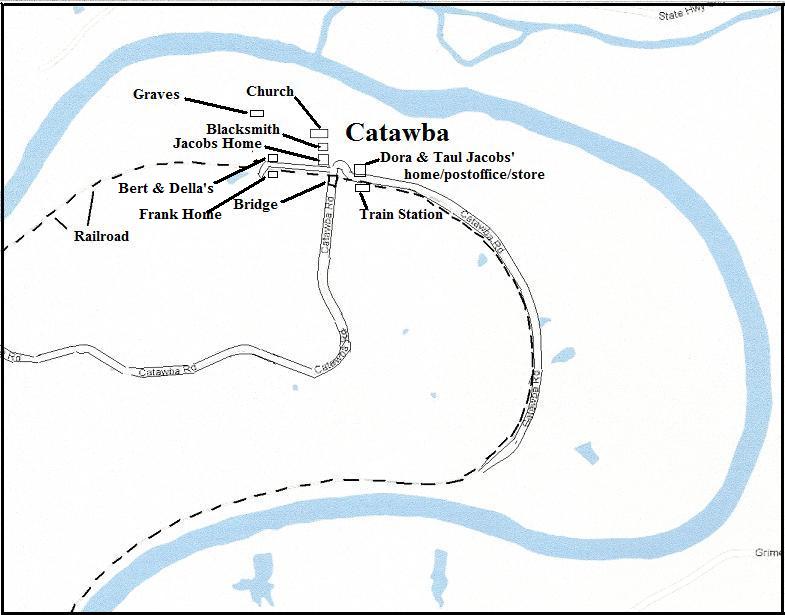 My Grandmother, Calla Della Jacobs, was born in Catawba, a Kentucky backwater community 30 miles south of the Ohio River and Cincinnati. Catawba owed its short existence to the Kentucky Central Railroad that built a line in 1852 from the Ohio river heading south through Falmouth, the capital of Pendleton County. Catawba developed amid side tracks and switching facilities five miles north of Falmouth. The Louisville & Nashville (L&N) Railroad acquired the line sometime around 1870. My great grandparents, Charles and Julia Jacobs (below), moved to the village during that decade.
 The Catawba Road runs east along a winding hog-back ridge from State Highway 27 before dropping into the river plain where the village once existed. The drive is picturesque, offering panoramic views into the ravines that lie on each side of the road.
Such hilly terrain poses problems to railroad builders as their objective is to maintain a level roadbed, so the tracks were laid along the route of least resistance - the flood plain of the Licking River. The railroad snakes its way north from Falmouth approximating the curves and bends of the Licking as it flows toward the Ohio. Catawba sat within a large horseshoe bend about five miles north of Falmouth.
The rail line ran through the village in a man-made trough twenty feet deep. The Catawba Road crossed the gap over a wooden bridge. My great grandparent's house sat directly facing the bridge on the far side of the tracks.  Their little home (above), sitting on a corner lot, had four rooms downstairs and two up. The front appeared, with a little imagination, to resemble a rectangular clown face with a tall window (eye) on each side of a narrow door (nose). The front door faced a narrow lane that ran parallel to the tracks.
  Turn left at the bridge and follow the narrow lane running in front of the house, and a person would arrive at the small house where Mom lived as a child (above). It was no more than a hundred yards down the lane. The place was very small but had two front doors in the center, like a duplex. The whole house could not have been larger than a couple hundred square feet. I don't know for what purpose it was originally build, but it sat on top of the bluff overlooking the train tracks below. Across the tracks on top the other side sat Mom’s Grandparent Frank's house.
  If one continued straight from across the bridge (east) on the lane that ran beside the house the next building encountered was a blacksmith shop. Grandma’s brother Clarence (Bud) became the owner of the family house after their parents died in 1912, It was his shop. Then the road started to make a hundred-eighty degree curve to the right (as shown on the above map), and at that point you would find the only church (above) in town. It was aligned with the other buildings so the road curved away from it. The church was a modest building with one large room and a bell tower near the front.
  The road continued its half-circle ending at another brother’s, William (Taul) and Dora (Frank) Jacobs house. Taul Jacobs was a covered bridge builder, and Dora ran the local post office. Their place was a wood framed structure built into the east bank of the railroad bed and facing the tracks. There is an old picture (above) of Mom, Hazel (Frank) Buckingham, when she was about two years old. It shows her sitting on the stone front step with her Uncle Taul in the background. She had a flower in her hair. In that picture she would be looking across the tracks to the train station on the opposite side.
Their little home (above), sitting on a corner lot, had four rooms downstairs and two up. The front appeared, with a little imagination, to resemble a rectangular clown face with a tall window (eye) on each side of a narrow door (nose). The front door faced a narrow lane that ran parallel to the tracks. Turn left at the bridge and follow the narrow lane running in front of the house, and a person would arrive at the small house where Mom lived as a child (above). It was no more than a hundred yards down the lane. The place was very small but had two front doors in the center, like a duplex. The whole house could not have been larger than a couple hundred square feet. I don't know for what purpose it was originally build, but it sat on top of the bluff overlooking the train tracks below. Across the tracks on top the other side sat Mom’s Grandparent Frank's house. If one continued straight from across the bridge (east) on the lane that ran beside the house the next building encountered was a blacksmith shop. Grandma’s brother Clarence (Bud) became the owner of the family house after their parents died in 1912, It was his shop. Then the road started to make a hundred-eighty degree curve to the right (as shown on the above map), and at that point you would find the only church (above) in town. It was aligned with the other buildings so the road curved away from it. The church was a modest building with one large room and a bell tower near the front. The road continued its half-circle ending at another brother’s, William (Taul) and Dora (Frank) Jacobs house. Taul Jacobs was a covered bridge builder, and Dora ran the local post office. Their place was a wood framed structure built into the east bank of the railroad bed and facing the tracks. There is an old picture (above) of Mom, Hazel (Frank) Buckingham, when she was about two years old. It shows her sitting on the stone front step with her Uncle Taul in the background. She had a flower in her hair. In that picture she would be looking across the tracks to the train station on the opposite side.
Wednesday, May 6, 2009
Origins
 I never thought about where I came from while I was growing up. I lived in a cozy microcosm, unconcerned with why I happen to be born in Kokomo, Indiana, or how my parents got there, or where they might have come from.
My world had little definition. We were on the East Coast for a while during World War II, and I remember taking rides in our 1936 Ford, but I was too young to know our whereabouts or the why of things. I looked out the car window at the passing scenery and accepted it with the ignorance and innocence of youth.
I have difficulty distinguishing between things I remember and remembering things I was told. Do I remember the 1936 Ford or do I remember being told about it? For a while my world was a street in Kokomo, but that eventually expanded to encompass towns to the south, family reunions, graveyards on Memorial Days, and a ghost town in Kentucky. I met people and heard stories of others who I‘d never met - people I discovered to be relatives - relatives with surnames different from my own - Frank, Jacobs, Manlove, and Muir. How could they all be related to me? The jumble of names, places, and stories made no sense - fit no pattern.
I was born in 1939 and things were very different from what they have become. The United States counted 132 million people - half of today’s population. Transportation was not so dynam
 ic as now - radio was popular, but there was no television. Computers and the Internet were inconceivable. Many of the families in the Midwest had been there for generations, and some of mine were among the original settlers.
 Most of my ancestors came into the Kentucky-Indiana-Ohio region in the early 1800’s - some before that. They came over roads no wider than narrow paths through a wilderness of old growth forest with trees reaching five to six feet in diameter.
Natives, “Indians”, as the European settlers mistakenly called them, were hostile. A book by Alan Eckert does a great job of describing those early days. The Friontiersman is a well documented chronicle depicting the adventures of Simon Kenton, Daniel Boone, and other early settlers into Kentucky. Eckert tells of the Shawnees who lived north of the Ohio River, of their hunting grounds in Kentucky, and the resulting conflict between them and the encroaching settlers.
I got interested in genealogy later in life. By then many people I would liked to have talked to were long dead. My research added more names to my ancestry list. Five generations back and a person can count sixteen Great-Great-Grandparents - sixteen surnames. I know fourteen of them. The number of ancestral names doubles with each succeeding generation - from 16 to 32, 64, 128... etc. There are over two thousand surnames possible in the twelfth generation. That reaches back in time to when the Pilgrims stepped into America by way of Plymouth Rock. I have traced a few back to colonial times, but am not yet able to brag about any being on the Mayflower.
But my interest is not in discovering Mayflower relatives or famous ancestors. It is in putting a personal face on history; on fitting those historical events and trends I studied in school into my own family history. My quest is to follow the threads of those disparate people, ancestors of mine, as they wove the fabric of my background. I hope to retrace the random paths they traveled which eventually converged to produce me.
Subscribe to:
Posts (Atom)