He set up his still in the basement of their house in Hooven. He made five or six batches a month and that produced three gallons of White Lightening. Mom didn't remember much about the still or its operation, but recalled he used lightening rods off barns for something. One time he got drunk and went to sleep so Mom’s brother Charlie finished distilling the whiskey. Grandma (below) delivered quart bottles of the stuff to a dentist or doctor in Cincinnati. She took the train and was usually accompanied by a neighbor lady.
 The drinking got worse, his mental state steadily deteriorated. The violent spells became more frequent, and the family lived in constant fear. Mom said she came to hate him. He beat Grandma, sometimes brutally, and one time he made the three kids sit in chairs while he sharpened his straight razor. He was drunk, and repeatedly threatened to cut their throats, one by one. Mom remembered being so frightened that her mouth went dry. She sat there afraid to move, afraid to draw attention to herself. All she could think about was how thirsty and scared she was.
The family moved to Connersville, Indiana in July 1922. Bert got a good job as the fireman at the electric plant. He worked there for a couple of years and quit. He mostly roamed around, and Mom didn't think he had any kind of a permanent job after that. She knew that Grandma didn’t get any support as she had to take in boarders and do laundry to make ends meet.
His mental condition kept getting worse, eventually degenerating to the point where he won't eat anything Grandma cooked. On one occasion he tore up most of the furniture in the house. The most violent episode occurred in 1924. He threw the dinner out into the yard and beat Grandma and his oldest son, Charlie. Later he woke thinking he had killed Grandma.
Mom’s half-brother, Art Lancaster, got the family back together. The following Sunday while the rest were at the grocery, Art confronted Grandpa about his drinking. Bert threw an iron at him. It bounced off the wall and stuck in the floor. Art hit him over the head with a glass bowl. They wrestled to the floor and Art ended on top and choked Pop into submission. Grandpa laid on a cot in the basement for a day or two and then his son, Joe, drove him to his brother’s home in Whitewater, OH. The family didn't see much of him after that.
He may have come back to Connersville one more time. One night during an electrical storm with lots of lightening and thunder, they a saw man that resembled my Grandfather standing on the street corner. He stood there in the rain a long time looking at the house, and finally moved on. Pieces of news came their way. Someone said he was hanging out at rough beer joints along the Ohio River, places called “Speak Easies” during Prohibition.
He probably drank anything with alcohol in it, and eventually got hold of some bad stuff. A popular drink during Prohibition was made from an extract of Jamaica Ginger. In the U.S. the concoction was called “Jake”. Some bootleggers laced it with a substance meant to fool import regulators at the Treasury Department. The additive was thought to be harmless, but many unlucky consumers discovered it to be toxic. It caused a paralysis known as "Jake Leg", a condition in which the afflicted walked with a odd gait in which the toe touched the ground before the heel. He never recovered. Bert Frank died at the University of Cincinnati Hospital on June 24, 1935. He was 54 years old.
GO TO: Part 4a, The Move to Kokomo, Indiana


 The steel mill manufactured iron ingots, and one fell on Grandpa’s foot. He hobbled around shoeless for several days, fussing incessantly, and finally escaping into drink. He got half-looped and decided it was time for a bath. The man had many faults but lack of hygiene was not among them. He took regular baths during an era when many insisted the act to be an unhealthy practice.
 I ask Mom about her earliest memory, and she recalled standing on the bridge next to Uncle Bud. The bridge spanned the train tracks not far from his shop. She said, “Uncle Bud stood beside me firing a rifle at the train that was passing under the bridge. Some years later she ask Grandma why he was doing that. Grandma was surprised to find that she had been on the bridge that day, and said Bud was really aiming at Uncle Bernard Frank (below, b.1894), Pop’s younger brother. The train was heading north toward Cincinnati, but I don't believe its direction mattered much to Great Uncle Bernard as it was a convenient and timely means of leaving the vicinity.”
 Bud developed the idea that Uncle Bernard was playing around with his wife Minnie. They socialized, playing cards, and people began talking. Mom’s brother, my Uncle Charlie, said that he once caught Uncle Bernard and Aunt Minnie in a compromising position and reckoned Uncle Bud had some justification for his suspicions.
 Dora (photo above) was married to Grandma's older brother Taul - a case of two siblings of one family (Grandma and Taul) married to two (Bert and Dora) of another. Mom said this was not uncommon as folks were less mobile due to the rough roads and slow horse travel. Many people spent their lives within a few miles of home. They often married neighbors; ones they had known all their lives, playmates of their youth.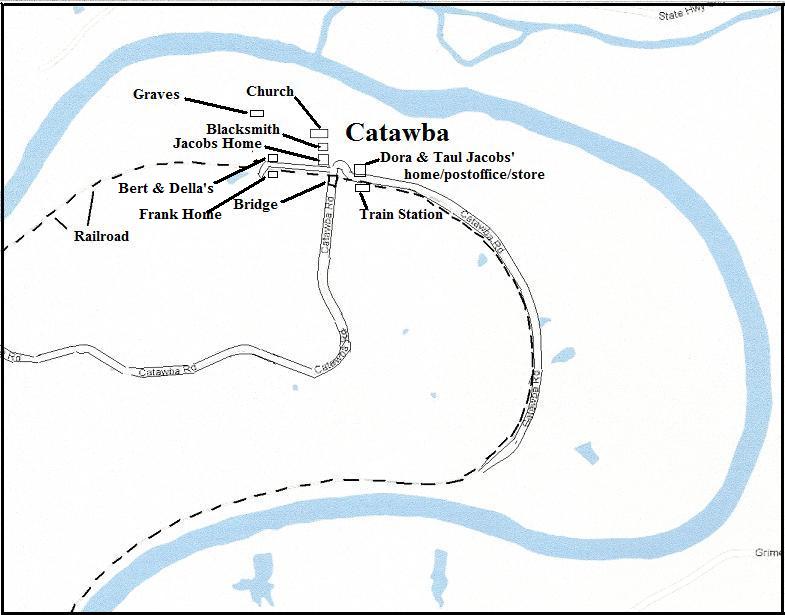
 The
The 
 Turn left at the bridge and follow the narrow lane running in front of the house, and a person would arrive at the small house where Mom lived as a child (above). It was no more than a hundred yards down the lane. The place was very small but had two front doors in the center, like a duplex. The whole house could not have been larger than a couple hundred square feet. I don't know for what purpose it was originally build, but it sat on top of the bluff overlooking the train tracks below. Across the tracks on top the other side sat Mom’s Grandparent Frank's house.
  If one continued straight from across the bridge (east) on the lane that ran beside the house the next building encountered was a blacksmith shop. Grandma’s brother Clarence (Bud) became the owner of the family house after their parents died in 1912, It was his shop. Then the road started to make a hundred-eighty degree curve to the right (as shown on the above map), and at that point you would find the only church (above) in town. It was aligned with the other buildings so the road curved away from it. The church was a modest building with one large room and a bell tower near the front.
  The road continued its half-circle ending at another brother’s, William (Taul) and Dora (Frank) Jacobs house. Taul Jacobs was a covered bridge builder, and Dora ran the local post office. Their place was a wood framed structure built into the east bank of the railroad bed and facing the tracks. There is an old picture (above) of Mom, Hazel (Frank) Buckingham, when she was about two years old. It shows her sitting on the stone front step with her Uncle Taul in the background. She had a flower in her hair. In that picture she would be looking across the tracks to the train station on the opposite side.