 I ask Mom about her earliest memory, and she recalled standing on the bridge next to Uncle Bud. The bridge spanned the train tracks not far from his shop. She said, “Uncle Bud stood beside me firing a rifle at the train that was passing under the bridge. Some years later she ask Grandma why he was doing that. Grandma was surprised to find that she had been on the bridge that day, and said Bud was really aiming at Uncle Bernard Frank (below, b.1894), Pop’s younger brother. The train was heading north toward Cincinnati, but I don't believe its direction mattered much to Great Uncle Bernard as it was a convenient and timely means of leaving the vicinity.”
 Bud developed the idea that Uncle Bernard was playing around with his wife Minnie. They socialized, playing cards, and people began talking. Mom’s brother, my Uncle Charlie, said that he once caught Uncle Bernard and Aunt Minnie in a compromising position and reckoned Uncle Bud had some justification for his suspicions.
Mom said that her Uncle Taul Jacobs, born in 1865, was by contrast, an even tempered fellow who built and repaired covered bridges in the surrounding counties. Sometime about when Grandma Julia Bailey Jacobs died in 1912 the two brothers ceased speaking - She never knew the reason. The only time they called a truce to their silence was when Mom stuck her fingers in the washing machine gears.
It was a cool day so Grandma had sat her on top the washer, thinking she’d be warmer. Mom promptly reached for the wrong thing and her finger tips slipped into the gears and were mashed and badly cut. Uncle Taul was right close but he and Grandma were not able to stop the bleeding. Taul knew that Uncle Bud had powdered resin at the shop that would stop it. They took Mom to Bud's and the brothers worked on her fingers until the emergency was over. They then reverted to shunning each other.
Mom’s Uncle Bud was the only one of his large family to operate an automobiles. None of his siblings drove. Uncle Taul tried once. His only attempt was in a neighbor’s fenced field but he gave it up after removing a good portion of the fence. Ironically Uncle Taul died in an auto accident in 1925. His son was driving in near-by Falmouth when the car was hit by a train at the main crossing. Uncle Bud was shot and killed by his son-in-law in 1957 - his end did not greatly surprise some people.
GO TO: Part 3d, Bert Frank


 Dora (photo above) was married to Grandma's older brother Taul - a case of two siblings of one family (Grandma and Taul) married to two (Bert and Dora) of another. Mom said this was not uncommon as folks were less mobile due to the rough roads and slow horse travel. Many people spent their lives within a few miles of home. They often married neighbors; ones they had known all their lives, playmates of their youth.
 I know more about his parents than I do of him. John N. Lancaster, his father, was born in Kentucky in 1840 and was living in Pendleton County by the time he was ten years old. He was still at home in 1860, but joined the Union Army in October of 1861, served in Company A, Kentucky 18th Infantry Regiment throughout the war. John N. was discharged in July 1865, and returned to Pendleton County to marry the widow Elizabeth Morgan Bowling shortly thereafter. I don’t know whether Elizabeth’s first husband, William Bowling, died in the war, but he was born in Virginia, and might have served for the Confederates in a Kentucky Mounted Infantry company.
 1903 must have been a terrible year for Grandma. Her brother Ben (above) came down with a mysterious illness. He was closest to her, both in age and companionship. Grandma nursed him, even though she was pregnant, but there was nothing to be done. He lay in bed with a fever for several months before he died. His parents buried him in their backyard in Catawba. Shortly after that Grandma had her baby, Mom’s half-brother Arthur. Her husband died just before or just after the birth, and she was left a widow with a young child to support and no way to make a living.
 Arthur was living with Bud, his wife Minnie, and two year old daughter, Mildred, in Catawba in 1920 (per US Census). It seems Bud had inherited the family home and started his blacksmith business. Sometime in the 1920’s Art moved to Connersville, Indiana to be with his mother and three half-siblings, Charlie, George (Joe), and Hazel (my mother). He married in about 1928 to Marjorie Louise May of Orange, Indiana. All my memories of Uncle Art and Aunt Marj are centered around their little farm on the edge of Orange. (Photo page 5 - Grandma, Uncle Art, and me)
 There is no telling now, but I can’t help to think that her life might have been happier if John P. had lived longer than the few years allotted him. Her second husband looked promising on the surface, but appearances can be deceiving.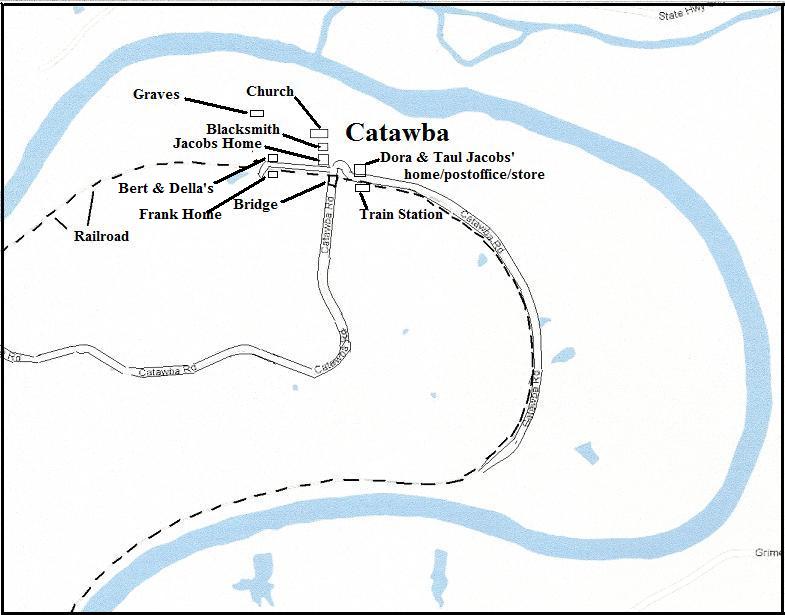
 The
The 
 Turn left at the bridge and follow the narrow lane running in front of the house, and a person would arrive at the small house where Mom lived as a child (above). It was no more than a hundred yards down the lane. The place was very small but had two front doors in the center, like a duplex. The whole house could not have been larger than a couple hundred square feet. I don't know for what purpose it was originally build, but it sat on top of the bluff overlooking the train tracks below. Across the tracks on top the other side sat Mom’s Grandparent Frank's house.
  If one continued straight from across the bridge (east) on the lane that ran beside the house the next building encountered was a blacksmith shop. Grandma’s brother Clarence (Bud) became the owner of the family house after their parents died in 1912, It was his shop. Then the road started to make a hundred-eighty degree curve to the right (as shown on the above map), and at that point you would find the only church (above) in town. It was aligned with the other buildings so the road curved away from it. The church was a modest building with one large room and a bell tower near the front.
  The road continued its half-circle ending at another brother’s, William (Taul) and Dora (Frank) Jacobs house. Taul Jacobs was a covered bridge builder, and Dora ran the local post office. Their place was a wood framed structure built into the east bank of the railroad bed and facing the tracks. There is an old picture (above) of Mom, Hazel (Frank) Buckingham, when she was about two years old. It shows her sitting on the stone front step with her Uncle Taul in the background. She had a flower in her hair. In that picture she would be looking across the tracks to the train station on the opposite side.