
It was a “cold attic”, meaning the temperature approximated the outside - cold in winter and like a sauna in summer. Insulation showed between rafters, so it was important to watch ones step. A few areas had been covered with boards, and that is where most of the stuff had been stored.
Many of the items were stimulants to memories of things gone by, like the box packed years ago with the first curtains to hang in our bedroom in 1950. They were of leafless trees, black skeletal trunks against a white background, cold and stark - an accurate interpretation of an Indiana winter.
There was the stand-alone floor model ash tray, an “art deco” model with a gaudy red body trimmed in flashy chrome. Don and I had given it to Mom for Christmas in about 1951.The top surface, a circular flying saucer shape with space on the outer edge to set drinks, sat on a conical pedestal with a chrome base. In the center, under a chrome plated handle, were chrome plated grooves for holding cigarettes around the edges of a chrome platted trap-door with a chrome plated button. Push the button, and the door opened to drop ashes and butts into a tray hidden below. For a lot of years it was an out-of-date piece of junk in the attic. Today it would be a sought-after collector item.
I made yet another trip to the attic in about 1992. Back in a corner, hidden behind some boxes, sat a large framed picture turned against the wall. I pulled it out to see a photo of a man sitting with his arm resting on a pedestal and a woman standing beside him. They were staring out toward me, but focused a bit to one side. He wore a beard, striped pants, black coat and vest; she stood in a floor length print dress that had an odd repeating design that suggested zodiac symbols. I guessed the photo to have been taken more than a hundred years before, possibly in about 1880.
My first thought was that it had been something Dad bought at one of the auctions he frequented, and it had been put in the attic and forgotten. He died in 1985 and Mom probably didn’t ventured up there any more. I took it down and showed it to her. She said it was a photo that our cousin, Jake, had brought back to Kokomo years ago. Jake died the year after Dad and the few personal items he left were up there in the attic, most of them in a old trunk.
 |
| "Jake" Jacobs, c. 1930, Connersville, IN |
He and his wife, Babe, stayed in Kokomo for a year or two and moved to Toledo, Ohio. They were eventually divorced and Jake showed back up in Kokomo in 1951. He got a job at the Stellite factory shortly after arriving, worked there till retirement and lived in Kokomo the rest of his life.
Jake was a eccentric character who stood only five feet tall, wore bib over-alls most of his life and expressed himself in a flow of colorful language, much of it with a blue tint. He rented a single room for many years just eight blocks west of us on Sycamore Street, and frequently stopped by the house. I never saw much of him after Grandma suffered a stroke. That was in 1958, right after my high school graduation, and ten years before she died. Mom said she’d see him from time to time after that. I don’t remember the last time I was with Jake, but he was fairly old and wrinkled.
The old photo Jake brought back from Kentucky was of my Great grandparents, Charles and Julia Jacobs, It measured about 16 by 24 inches. The bottom had some water damage, but the rest was okay. I took it out of the frame and packed it back to Alaska where a photo shop produced a useable image. I salvaged something for posterity, and it was also a great find because I had just become interested in genealogy. The photo is the only one I have of direct ancestors who died before I was born.


 The steel mill manufactured iron ingots, and one fell on Grandpa’s foot. He hobbled around shoeless for several days, fussing incessantly, and finally escaping into drink. He got half-looped and decided it was time for a bath. The man had many faults but lack of hygiene was not among them. He took regular baths during an era when many insisted the act to be an unhealthy practice.
 I ask Mom about her earliest memory, and she recalled standing on the bridge next to Uncle Bud. The bridge spanned the train tracks not far from his shop. She said, “Uncle Bud stood beside me firing a rifle at the train that was passing under the bridge. Some years later she ask Grandma why he was doing that. Grandma was surprised to find that she had been on the bridge that day, and said Bud was really aiming at Uncle Bernard Frank (below, b.1894), Pop’s younger brother. The train was heading north toward Cincinnati, but I don't believe its direction mattered much to Great Uncle Bernard as it was a convenient and timely means of leaving the vicinity.”
 Bud developed the idea that Uncle Bernard was playing around with his wife Minnie. They socialized, playing cards, and people began talking. Mom’s brother, my Uncle Charlie, said that he once caught Uncle Bernard and Aunt Minnie in a compromising position and reckoned Uncle Bud had some justification for his suspicions.
 Dora (photo above) was married to Grandma's older brother Taul - a case of two siblings of one family (Grandma and Taul) married to two (Bert and Dora) of another. Mom said this was not uncommon as folks were less mobile due to the rough roads and slow horse travel. Many people spent their lives within a few miles of home. They often married neighbors; ones they had known all their lives, playmates of their youth.
 I know more about his parents than I do of him. John N. Lancaster, his father, was born in Kentucky in 1840 and was living in Pendleton County by the time he was ten years old. He was still at home in 1860, but joined the Union Army in October of 1861, served in Company A, Kentucky 18th Infantry Regiment throughout the war. John N. was discharged in July 1865, and returned to Pendleton County to marry the widow Elizabeth Morgan Bowling shortly thereafter. I don’t know whether Elizabeth’s first husband, William Bowling, died in the war, but he was born in Virginia, and might have served for the Confederates in a Kentucky Mounted Infantry company.
 1903 must have been a terrible year for Grandma. Her brother Ben (above) came down with a mysterious illness. He was closest to her, both in age and companionship. Grandma nursed him, even though she was pregnant, but there was nothing to be done. He lay in bed with a fever for several months before he died. His parents buried him in their backyard in Catawba. Shortly after that Grandma had her baby, Mom’s half-brother Arthur. Her husband died just before or just after the birth, and she was left a widow with a young child to support and no way to make a living.
 Arthur was living with Bud, his wife Minnie, and two year old daughter, Mildred, in Catawba in 1920 (per US Census). It seems Bud had inherited the family home and started his blacksmith business. Sometime in the 1920’s Art moved to Connersville, Indiana to be with his mother and three half-siblings, Charlie, George (Joe), and Hazel (my mother). He married in about 1928 to Marjorie Louise May of Orange, Indiana. All my memories of Uncle Art and Aunt Marj are centered around their little farm on the edge of Orange. (Photo page 5 - Grandma, Uncle Art, and me)
 There is no telling now, but I can’t help to think that her life might have been happier if John P. had lived longer than the few years allotted him. Her second husband looked promising on the surface, but appearances can be deceiving.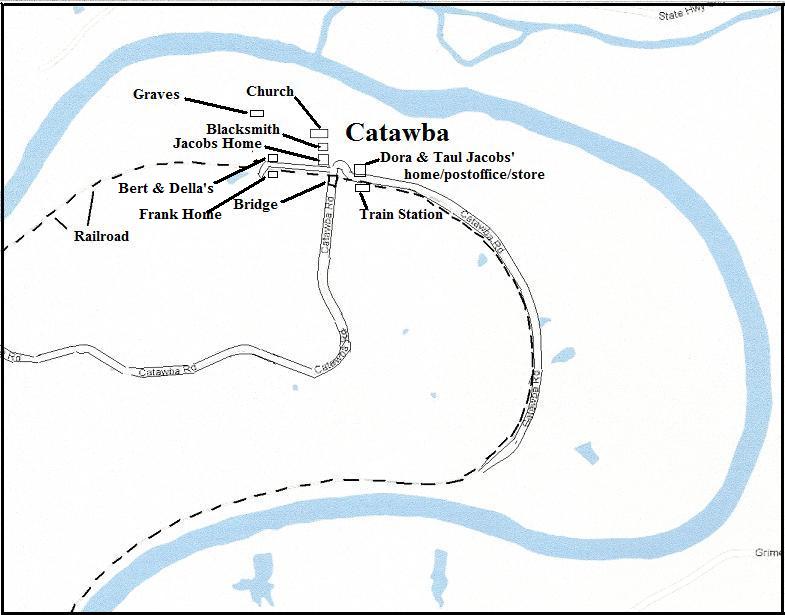
 The
The 
 Turn left at the bridge and follow the narrow lane running in front of the house, and a person would arrive at the small house where Mom lived as a child (above). It was no more than a hundred yards down the lane. The place was very small but had two front doors in the center, like a duplex. The whole house could not have been larger than a couple hundred square feet. I don't know for what purpose it was originally build, but it sat on top of the bluff overlooking the train tracks below. Across the tracks on top the other side sat Mom’s Grandparent Frank's house.
  If one continued straight from across the bridge (east) on the lane that ran beside the house the next building encountered was a blacksmith shop. Grandma’s brother Clarence (Bud) became the owner of the family house after their parents died in 1912, It was his shop. Then the road started to make a hundred-eighty degree curve to the right (as shown on the above map), and at that point you would find the only church (above) in town. It was aligned with the other buildings so the road curved away from it. The church was a modest building with one large room and a bell tower near the front.
  The road continued its half-circle ending at another brother’s, William (Taul) and Dora (Frank) Jacobs house. Taul Jacobs was a covered bridge builder, and Dora ran the local post office. Their place was a wood framed structure built into the east bank of the railroad bed and facing the tracks. There is an old picture (above) of Mom, Hazel (Frank) Buckingham, when she was about two years old. It shows her sitting on the stone front step with her Uncle Taul in the background. She had a flower in her hair. In that picture she would be looking across the tracks to the train station on the opposite side.